
Ingredients
Hibiscus
Hibiscus sabdariffa
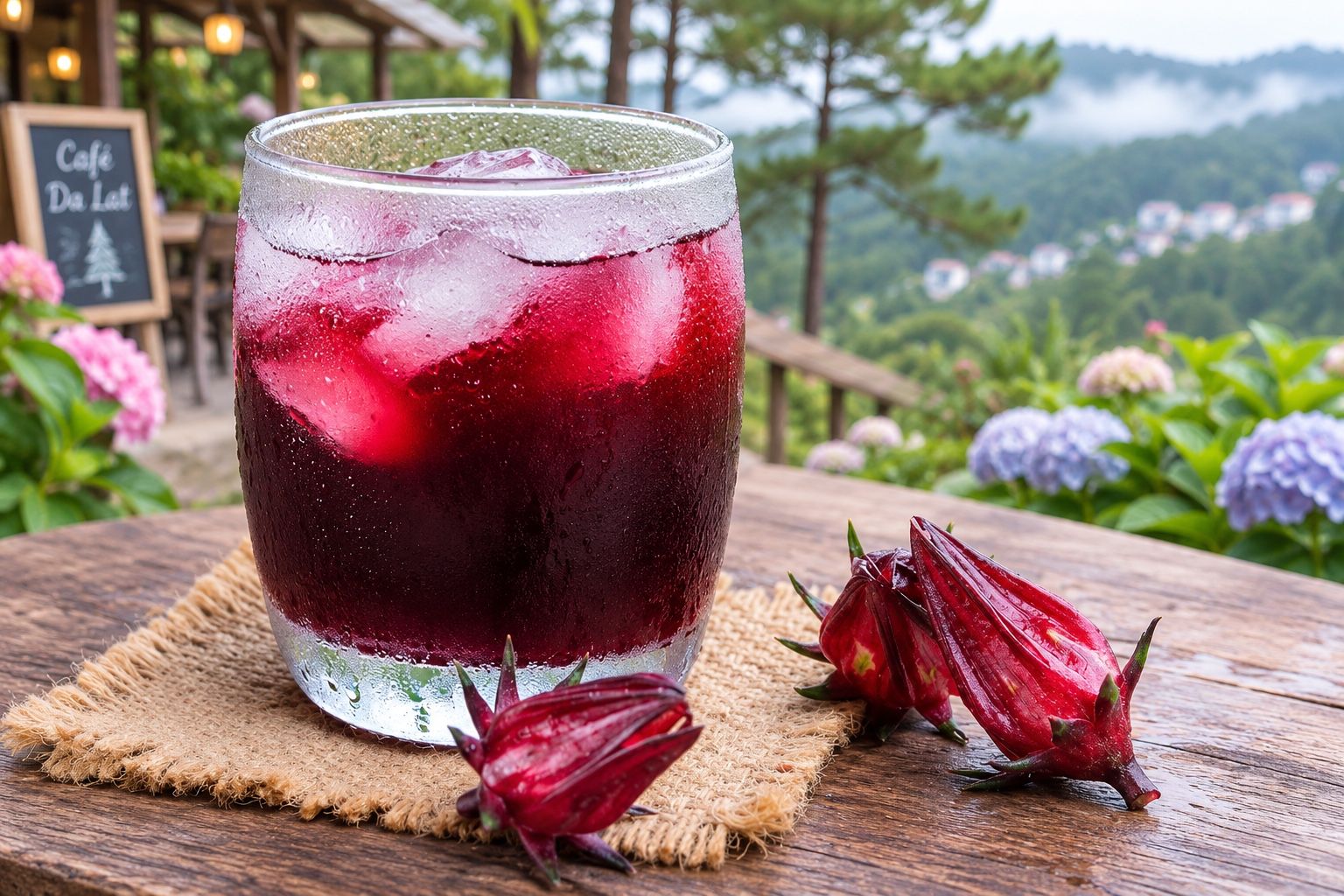
Hibiscus is the deep red, sour flower behind our Hibiscus cider. In Việt Nam you will rarely hear it called that. Here it is bụp giấm, atiso đỏ, hoa vô thường, đay Nhật or lạc thần hoa, depending on who you ask.
All of those names belong to one plant, Hibiscus sabdariffa, known in English as roselle. This page sorts out the names, where the plant came from, and what people here do with it.
One plant, many names
- Bụp giấm. The textbook name. Bụp is the southern word for hibiscus, as in bông bụp, and giấm is vinegar: the hibiscus that is as sour as vinegar.
- Atiso đỏ. “Red artichoke”, and the name on most jars of tea, syrup and jam. It is not an artichoke and is not related to the atisô grown around Đà Lạt. Nobody seems sure where the name started, though the plump red calyx does look a little like a small artichoke bud.
- Hoa vô thường. Literally “flower of impermanence”, vô thường being the Buddhist word for it. The most poetic of the lot.
- Đay Nhật. “Japanese jute”. Đay is jute, and the name points at the plant’s other life: tall varieties of roselle are grown across Asia for the fibre in their stems rather than for their calyces.
- Lạc thần hoa. The Sino-Vietnamese reading of the plant’s Chinese name, 洛神花.
There are more local ones, such as bụp chua, and most of them say the same thing: it is sour.
And then there is hibiscus, the name on our label and the one most of the world uses for the drink. Strictly, Hibiscus is a whole genus of several hundred species, including dâm bụt, the ornamental hibiscus in every other garden hedge. Only this one is grown to be eaten and drunk.
Where it comes from
Roselle is most probably African. Botanists think it was first domesticated for its seeds, perhaps as early as 4000 BC in what is now Sudan, and that eating the leaves and the calyces came later. That is still where some of its best-known drinks are: karkadé in Egypt and Sudan, bissap in Senegal.
From Africa it travelled. The types grown for their leaves and calyces reached the Americas and Asia around the 17th century, which is how Mexico got agua de Jamaica and the Caribbean got sorrel. The fibre types followed in the early 20th century.
PROSEA, the standard reference on South-East Asian crops, records roselle being introduced into Việt Nam in 1957. Growers near Huế tell a later chapter: a German professor who brought seed in 1992 to study the plant, with the Vietnamese scientist Mai Thị Tấn carrying on the work after he went home. Either way, it has settled in. It is now grown in Bình Thuận, Đồng Nai, Lâm Đồng and the sunny central provinces, and around Phong Điền near Huế it has replaced cassava and beans on tens of hectares.
The plant is an annual that grows 1.5 to 2 m tall in a season. What gets harvested is not really the flower. The blossom itself is pale and short-lived. Once it drops, the calyx around the seed pod swells into a fleshy, deep red cup, and that is the part people pick, from about September to November.
How Việt Nam uses it
Most of it ends up in a glass. Dried calyces are steeped as tea, hot or iced, which comes out ruby red and properly sour.
Fresh ones are layered with sugar in a jar. After a few days you have two things: the syrup, which is diluted with water and ice for a cold drink, and the candied calyces themselves, eaten as mứt.
It also goes into the pot. Canh chua is the sour soup of the south, on the table from Sài Gòn to Cần Thơ and all through the Mekong Delta. Tamarind is the usual souring ingredient, but hibiscus leaves and calyces do the same job, and cooks like them with catfish in particular.
And some of it is steeped in rice spirit or made into wine, which is the part of the tradition closest to what we do.
You will find it in pharmacies too, with a long list of health claims attached. We will leave those to others. We use it because it tastes good.
How we use it
Our Hibiscus cider was inspired by a single moment: a taste of fresh hibiscus, picked straight from the bush on a trek through Đắk Lắk’s highlands.
The first idea was not a drink at all. The plan was to make some kind of fruit jam out of it. Then came the idea of fermenting it instead, and around 2019 that became our Hibiscus cider. Strictly speaking it is not a cider, since the base is hibiscus tea instead of apple. We call it one because it is fermented, sparkling and drinks like one. There was no recipe to follow, so every batch was a small adventure into unknown territory.
Our hibiscus comes from Việt Nam’s central highlands. It gives the cider its colour and its tartness, and we round it out with a little cinnamon and ginger. It finishes at about 4.8% and demi-sec, and has won an Untappd Community Award three years running.
What to expect in the glass: bold and tart, with warm spice behind it. It stands up well to spicy food, such as bún bò Huế, nem nướng or roast duck, and it makes a good spritz.
Frequently Asked
What is hibiscus called in Vietnamese?
It has several names. Bụp giấm and atiso đỏ are the two you will hear most; hoa vô thường, đay Nhật and lạc thần hoa are the same plant. All of them are Hibiscus sabdariffa, called roselle in English.
Is atiso đỏ an artichoke?
No. Atiso đỏ means red artichoke, but the plant is a hibiscus, in the mallow family. The artichoke grown around Đà Lạt (atisô, Cynara scolymus) is a thistle and a completely different plant. They share a name and nothing else.
Is it the same hibiscus that grows in gardens?
No. The ornamental hibiscus in hedges and gardens, dâm bụt or bông bụp, is Hibiscus rosa-sinensis and is grown for its flowers. The sour one used in drinks is Hibiscus sabdariffa, grown for the red calyx that forms after the flower has fallen.
What is roselle?
Roselle is the English name for Hibiscus sabdariffa. It is the plant behind hibiscus tea, Egyptian karkadé, Senegalese bissap, Mexican agua de Jamaica and Caribbean sorrel.
Which part of the plant is used?
The calyx, not the petals. Once the pale flower drops, the calyx around the seed pod swells into a fleshy, deep red cup. That is what gets picked, and what people call the hibiscus flower.
What does hibiscus taste like?
Sour first, a clean fruity tartness often compared to cranberry, with a light floral note and a little grip at the end. It also gives a strong ruby colour to anything it touches.
Is hibiscus native to Việt Nam?
No. It most probably comes from Africa and reached Asia as a vegetable crop around the 17th century; records note its introduction into Việt Nam in 1957. Today it is grown in many parts of Việt Nam, from Bình Thuận and Đồng Nai to Lâm Đồng and the central provinces.
When is hibiscus season in Việt Nam?
The main harvest runs from about September to November. The calyces are used fresh in season and dried for the rest of the year.
Is Bazan's Hibiscus cider really a cider?
Strictly speaking, no. Cider is made from apples, and ours starts from hibiscus tea. It is sparkling, about 4.8%, and drinks like a cider, which is why we call it one.
How strong is Bazan's Hibiscus cider?
About 4.8% ABV, demi-sec, with a little cinnamon and ginger alongside the hibiscus.
Where can I try or buy it?
It is poured and sold in bars, restaurants and shops. Message us on Facebook or through our contact form and we will point you to the nearest one.